
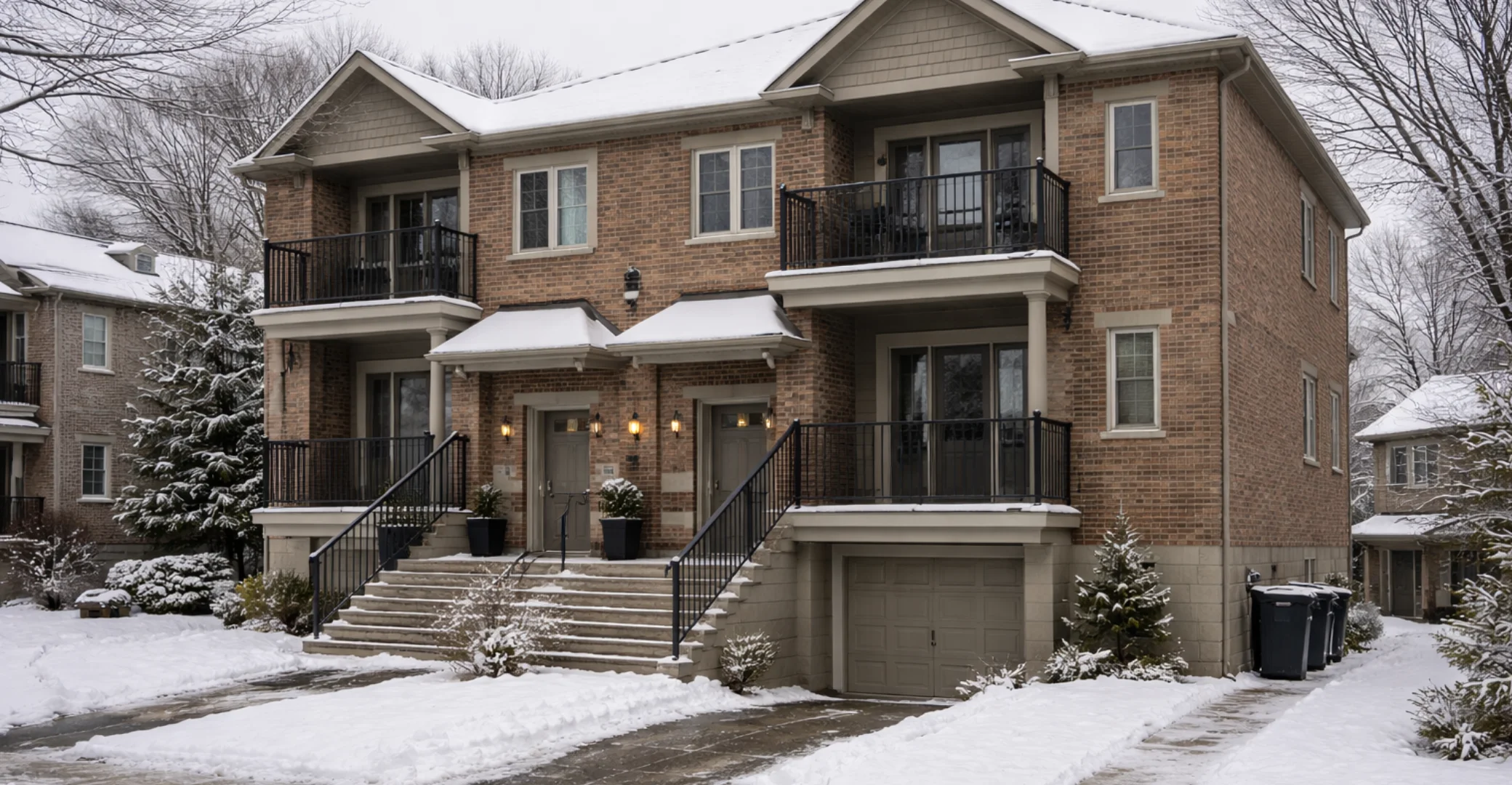
Duplexes and triplexes sit in the “missing middle” category—small-scale multi-unit housing that’s denser than a single-family home, but far below mid- and high-rise buildings. In Ontario, this property type is getting more attention in 2026 because investors are trying to balance three pressures at once: higher borrowing costs, affordability constraints, and strong rental demand. “Missing middle” housing is also increasingly viewed as part of the supply solution across Canadian markets [1].
In summary: Duplexes and triplexes can be smart Ontario investments in 2026 when (1) rents support your carrying costs, (2) you can manage conversion or compliance risk, and (3) you’re buying in an area with stable rental demand and long-term resale liquidity. The best deals are usually the ones where you can improve the asset (legalization, layout efficiency, energy upgrades, secondary suite optimization) without relying on aggressive appreciation assumptions.
Table of Contents
- What counts as a duplex or triplex in Ontario?
- Why investors like duplexes and triplexes in 2026
- Cash flow in 2026: what to model
- Legal and compliance basics in Ontario
- Where duplex/triplex investing works best
- A simple decision framework
- FAQs
What Counts as a Duplex or Triplex in Ontario?
In practical investment terms, a duplex is a property with two self-contained units, and a triplex has three self-contained units. Units typically include separate kitchens, bathrooms, living areas, and legal egress. In Ontario, the real-world complexity isn’t the label—it’s whether the units are legal, conforming, and insurable.
You’ll see duplex/triplex opportunities in two common forms:
- Purpose-built multiplex (constructed as 2–3 units from the start)
- Conversion (a single-family home converted into 2–3 units, or a home with a second unit plus additional configuration)
Conversions can create value, but they also introduce the biggest risk bucket: permits, building code compliance, zoning interpretation, and insurance underwriting. That’s why investors should treat “duplex/triplex” as an operating business model, not just a property type.
Why Investors Like Duplexes and Triplexes in 2026
Investors gravitate to duplexes and triplexes in 2026 because they can offer a more resilient income profile than single-unit rentals. When you spread income across 2–3 units, a vacancy or turnover doesn’t zero out your revenue. This matters in a market where investors are prioritizing stability and underwriting discipline.
There are also macro tailwinds supporting rental-oriented housing supply. Nationally, CMHC has highlighted the growing role of rental construction and the importance of supply in easing market pressures [2]. While your purchase is not “new construction,” demand patterns often track the same realities: more renters competing for suitable housing, and more attention on medium-density options.
In addition, multi-unit properties align well with an Ontario investment approach that prioritizes:
- Income durability (multiple leases, diversified rent stream)
- Operational upside (unit optimization, renovations, legalization)
- Exit optionality (sell to investors, end-users, or reposition)
Finally, Ontario market forecasts continue to emphasize a measured recovery path with activity expected to improve in provinces like Ontario as conditions normalize [3]. For investors, that generally supports the logic of buying assets that can perform through multiple scenarios, not only in a rapid appreciation cycle.
Ready to Find Your Dream Home with Bridge ?
Whether you’re a first-time buyer or moving up to your forever home, Bridge guides you through every step — from tailored property searches to expert negotiations — so you can buy with confidence.
Cash Flow in 2026: What to Model (So You Don’t Get Surprised)
If you’re investing in Ontario in January 2026, your underwriting needs to be conservative. Duplexes and triplexes can cash flow, but only when the math is grounded in real expenses and realistic rents.
At minimum, build your model around these line items:
- Mortgage payment (stress-tested: model +1% rate scenario)
- Property taxes (verify current + reassessment risk)
- Insurance (multiplex policies can be materially higher than single-family)
- Utilities (who pays? separately metered?)
- Repairs & maintenance (budget per unit, not per property)
- Vacancy allowance (even if the market is tight)
- Property management (even if self-managing—price your time)
- Capital reserves (roof, HVAC, windows, plumbing, electrical)
Investor reality check: The best duplex/triplex deals in 2026 are usually not the ones with the flashiest pro forma. They’re the ones where the current income is stable and the future upside is achievable through clear steps (legalization, layout improvements, separate meters, energy efficiency, rent optimization).
If you want a related framework, link this page internally to your broader investor strategy content (example: Ontario investment strategies right now) and your cash flow vs appreciation breakdown (example: Cash flow vs appreciation in Ontario).
Legal and Compliance Basics in Ontario
The biggest difference between a “good” duplex/triplex and a “bad” one is rarely the neighbourhood—it’s the compliance status. Ontario provides guidance on adding a second unit, including the need for building permits and working with your local building department [4]. That same logic applies to multiplex conversions: legal status matters for safety, resale, and insurance.
Before you buy, treat the following as non-negotiable due diligence steps:
- Confirm unit legality: ask for permits, final inspections, and compliance documentation.
- Verify zoning and use: confirm the property’s permitted use for the number of units.
- Check fire separation and egress: especially for conversions and basement units.
- Confirm parking and access: some municipalities enforce minimums; others are flexible.
- Insurance underwriting: get quotes early—don’t assume insurability.
Important: Rules and enforcement vary by municipality. Always confirm with the local building/planning department and qualified professionals (lawyer, inspector, contractor, and insurance broker) before relying on a conversion plan.
Where Duplex and Triplex Investing Works Best in Ontario
Duplexes and triplexes perform best in Ontario where rental demand is consistently supported by employment, education, transit, and constrained housing options. You’re not only buying rent today—you’re buying future tenant depth and future resale liquidity.
Look for markets with:
- Strong rental absorption (units lease quickly at market rents)
- Stable or growing population drivers (jobs, schools, infrastructure)
- Older housing stock (more conversion opportunities—but higher inspection diligence)
- Clear municipal pathways for additional units and compliance
Ontario examples often include parts of the GTA (depending on acquisition price), Hamilton, Niagara-region hubs, and university-adjacent areas—where demand for multiple smaller units can remain strong through market cycles. However, the “best” location is always the one where your numbers work with a realistic risk buffer.
A Simple Decision Framework: Is This Duplex/Triplex Smart for You in 2026?
Use this framework to decide quickly, without overcomplicating analysis:
1) Can the income carry the asset?
If you need optimistic rent growth to break even, it’s likely not the right deal for 2026. Aim for stability first; upside second.
2) Is the compliance status clear?
If the units are not clearly legal or insurable, price the risk correctly—or walk away. Compliance ambiguity is a hidden cost that can destroy returns.
3) Do you have an operational plan?
Multiplex investing is more like running a small operating business. If you don’t want tenant and maintenance complexity, choose a simpler asset class.
4) Is your exit strategy realistic?
Know who will buy it from you: another investor, an end-user, or a builder. Your exit affects how you underwrite improvements and risk tolerance.
If you can answer “yes” to all four, duplexes and triplexes can be a strong Ontario investment move in 2026—especially for investors prioritizing income stability and controllable value-add.
FAQs: Duplex and Triplex Investment Ontario
- Are duplexes and triplexes good investments in Ontario in 2026?
They can be, especially when income is stable and compliance risk is low. The strongest deals are those where you can improve cash flow through clear operational steps instead of relying on market appreciation alone. - Is a duplex safer than a single-family rental?
Often, yes. A duplex spreads income across two units, so vacancy risk is lower than a single-unit rental—assuming both units are legal and the property is well maintained. - What’s the biggest risk with duplex or triplex conversions?
Compliance and insurability. If units weren’t built or renovated with permits and code compliance, you may face retrofit costs, insurance issues, or resale complications [4]. - Do duplexes and triplexes cash flow better than condos?
They can, because you control expenses more directly and can often optimize unit layouts. Condos introduce fee and governance risk that can compress long-term cash flow. - Should investors focus on “missing middle” housing in 2026?
Missing middle housing is increasingly recognized as part of Canada’s supply conversation, and it aligns with investor demand for resilient income-oriented housing [1].
Sources
- CMHC — How Common is the “Missing Middle” Housing in Canada? (Oct 23, 2025)
- CMHC — Housing Supply Report (Fall 2025)
- CREA — Resale Housing Market Forecast for 2026 (Jan 2026)
- Government of Ontario — Add a second unit in your house